
With the current Eskom crisis, load shedding has become part of of our daily lives. This has a huge impact on how we see our security at home, complexes and communities. We have customized our DC UPSes in order to provide cost effective UPS backup for individuals and companies with security equipment like CCTV solutions, PTZ cameras, numberplate recognition cameras, etc. Our DC UPSes are capable of providing UPS backup for POE devices directly, eliminating the need for Power Injectors and can also power 48V and 53V POE switches from a 48V DC port.
In this case study we want to demonstrate how DC UPSes can provide cost effective UPS backup for bigger loads than the average private home requirements.
Our client required a cost effective solution to provide UPS backup to 18 locations and 40 cameras.
Client Requirement:
- Needs a cost-effective solution to provide at least 4 hours of backup time during load shedding.
- Solution must re-use most current equipment (switches, cameras etc.)
- Rewiring must be avoided as far as possible.
- Solution must be easy to deploy. (plug and play)
- Devices must auto start after prolonged outages.
| Location | Rocket M2 | Switch - SPS-4F2F | DS-2CDD4A26FWD-IZS | DS-2CD2T26G1-2I | POE Injector | Solution |
| 1 | 1 | 1 | 0 | 1 | 1 | 1 |
| 2 | 1 | 1 | 0 | 1 | 1 | 1 |
| 3 | 1 | 1 | 0 | 1 | 1 | 1 |
| 4 | 1 | 1 | 0 | 1 | 1 | 1 |
| 5 | 1 | 1 | 0 | 2 | 1 | 1 |
| 6 | 1 | 1 | 0 | 2 | 1 | 1 |
| 7 | 1 | 1 | 0 | 2 | 1 | 1 |
| 8 | 1 | 1 | 0 | 2 | 1 | 1 |
| 9 | 1 | 1 | 0 | 2 | 1 | 1 |
| 10 | 1 | 1 | 0 | 2 | 1 | 1 |
| 11 | 1 | 1 | 1 | 2 | 1 | 2 |
| 12 | 2 | 1 | 1 | 2 | 2 | 2 |
| 13 | 2 | 1 | 1 | 2 | 2 | 2 |
| 14 | 1 | 1 | 1 | 2 | 1 | 2 |
| 15 | 2 | 1 | 1 | 2 | 2 | 2 |
| 16 | 1 | 1 | 1 | 2 | 1 | 2 |
| 17 | 1 | 1 | 1 | 2 | 1 | 2 |
| 18 | 2 | 1 | 1 | 2 | 2 | 2 |
POC Testing:
Proof of concept testing was conducted at location 18 at night with IR enabled as it presents the worst-case scenario.
Initial power requirements for location 18 as per the equipment's maximum power consumption ratings provided in the table below:
| Device | Power Rating | Max Watt |
| POE Switch SPS-4F2F | Power Supply 52V 1.25A | 65 |
| Camera - DS-2CD4A26FWD-IZS | 12 VDC, max. 13.3W, 1.2A; PoE, max. 17.6W, 0.3A to 0.5A | 17.6 |
| Camera - DS-2CD2T26G1-2I | 12 VDC, 0.9A, max: 10W, PoE: 0.3A to 0.1A, max: 12.5W | 12.5 |
| Camera - DS-2CD2T26G1-2I | 12 VDC, 0.9A, max: 10W, PoE: 0.3A to 0.1A, max: 12.5W | 12.5 |
| Rocket M2 (Ubiquiti) | POE Injector 24V, 1A | 24 |
| Rocket M2 (Ubiquiti) | POE Injector 24V, 1A | 24 |
| Total Watts | 155.6 |
The following configuration was used for the POC to get an estimate of the actual DC watt requirement.
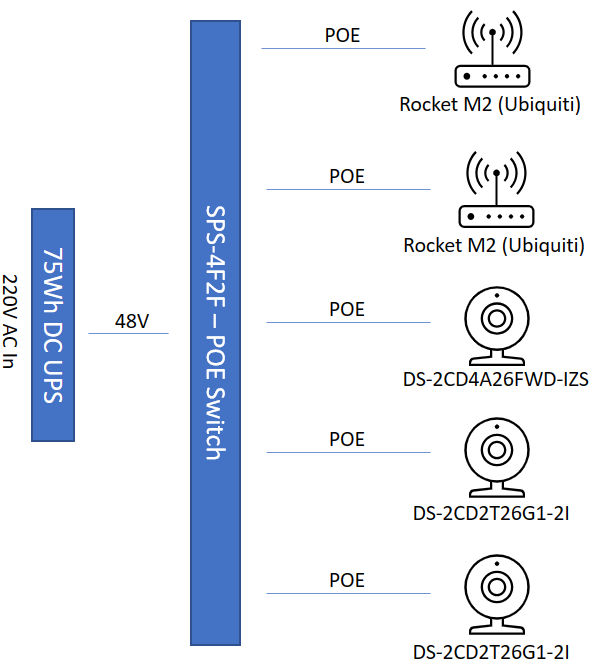
During the POC the watt utilization on the UPS did not exceed 35 watts. The DS-2CD4A26WD-IZS consumed the most power, +- 13 to 15 watts.
Deployed Solutions:
Deployed Solution 1 (Location 1 to 10):
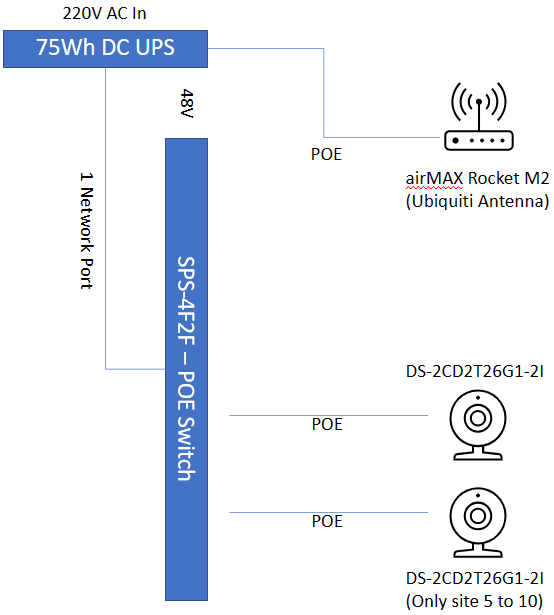
Deployed Solution 2 (Location 11 to 18):
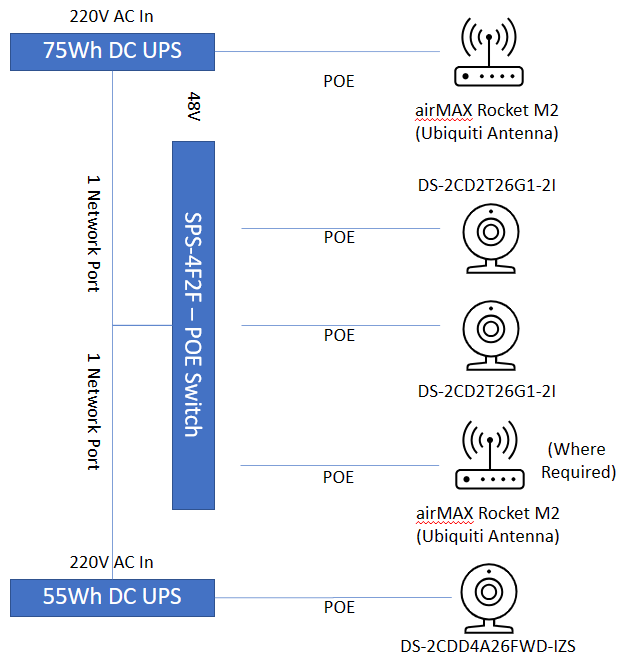
Key conclusions:
- Always measure actual DC watt requirement, the POC location maximum watt requirements were calculated at over 155 watts but rarely required 35 watts through the UPS. This is possibly due to the following:
- Equipment rarely used the max rated power.
- The power supply ratings have huge overhead due to the fact that AC power is converted to DC.
- The DC UPS directly provide DC power to the devices without AC conversion overhead.
- The use of multiple DC UPSes for bigger loads is still cost effective compared to alternative solutions.